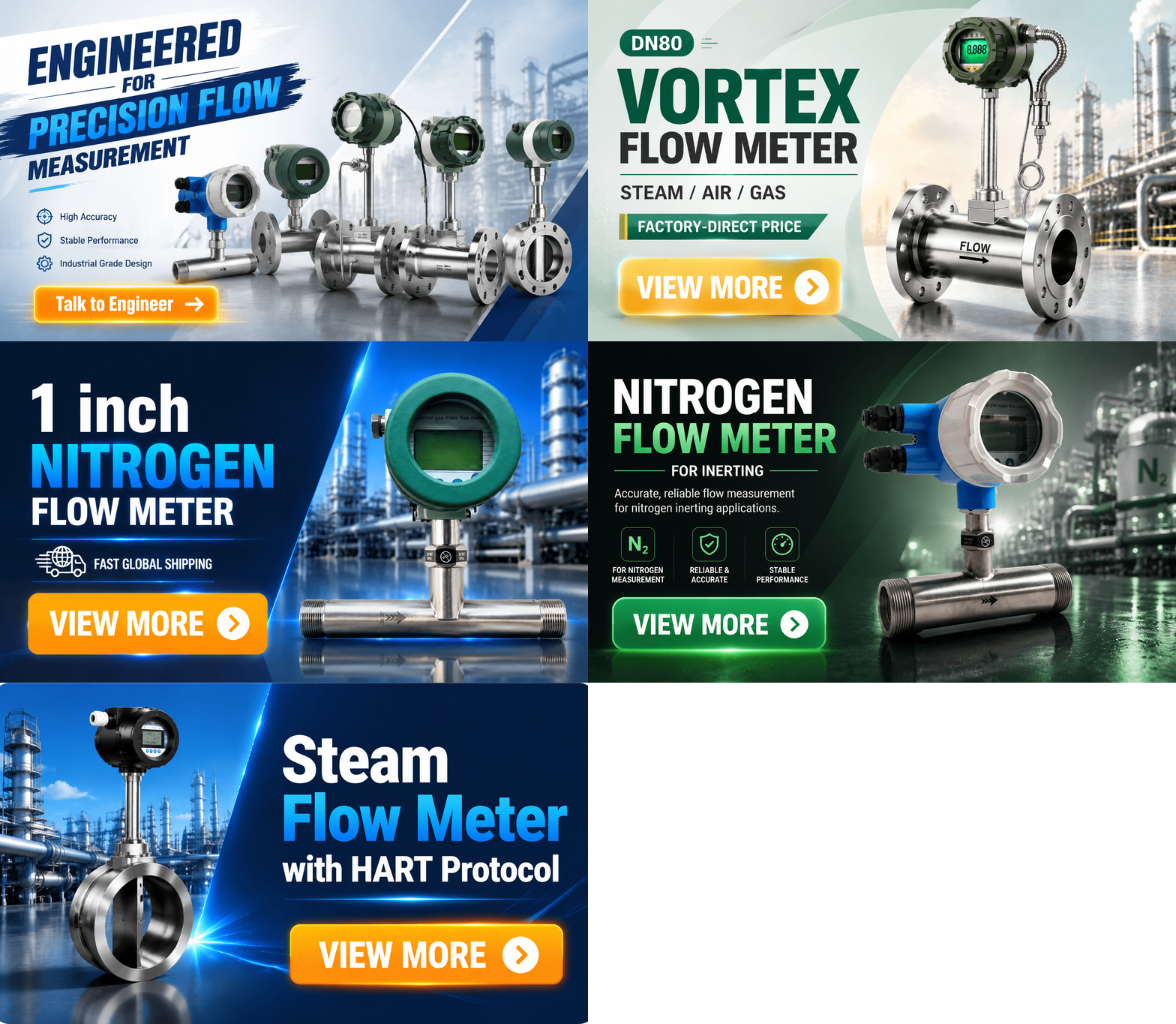
Steam mass flowmeter

niotall6efbc

DateTime 07/16/2026 Show 105
What flow meters are commonly used for steam flow measurement? | Types of flow meters and their advantages and disadvantages. | What is the equivalent mass flow rate of kg/h for 1 Nm3 of steam|

Price:¥1.00Quantity:9999

Market Price:¥1.00Reduced Price:¥1.00

Effevtive Time:7/8/2026

Sale Address:SilverProduction Address:Silver automation instruments

Keywords:What flow meters are commonly used for steam flow measurement? | Types of flow meters and their advantages and disadvantages. | What is the equivalent mass flow rate of kg/h for 1 Nm3 of steam|

Phone:QQ:Click:WhatsApp: +86 18936759191

Company:non invasive flow meter

『Steam mass flowmeter』Related information(clamp on meter|electromagnetic meter|venturi meterrotameter|orifice meter|ultrasonic flow meter|mass flow meter|coriolis mass flow meter|coriolis flow meter|magnetic flow meter|magmeter flow meter|magflow flow meter|mag meter flow meter|electromagnetic flow meter|vortex flow meter|turbine flow meter|thermal mass flow meter|thermal flow meter|rotameter flow meter)

What is the mass flow rate of kg/h equivalent to 1.1 Nm3 of steam? We need to find the conversion relationship between the reading (T) of the steam flowmeter and the unit Nm3. Firstly, we need to understand the relationship between the reading of the steam flow meter and the volume of steam. The reading (T) of a steam flow meter usually represents the mass flow rate of a single unit, usually in kg/h or lb/h. And Nm3 is a volumetric unit that represents the volume at standard atmospheric pressure and dry mountain macro temperature (0 degrees Celsius or 273.15 Kelvin). To convert the reading of the steam flowmeter to Nm3, we need to consider the pressure and temperature of the steam. The conversion formula is usually: T=Nm3 × (ρ _steam/ρ _ air), where ρ _steam is the density of steam and ρ _ air is the density of air. But in this issue, we did not provide the density of the steam, so we cannot perform a complete calculation. To simplify the problem, we can assume that the density of steam is similar to that of water, about 1000kg/m3. Meanwhile, we also assume that the density of air is 1.225kg/m3. By substituting these values into the formula, the answer can be obtained. The conversion factor is 816.33 kg/m3 per Nm3, so every 1 Nm3 of steam is equivalent to a mass flow rate of 816.33 kg/h.

2. Types of flow meters and their advantages and disadvantages Notes

Types of flow meters and their advantages and disadvantages Summary of differential pressure flow meters (DP flow meters) Principle: Based on the pressure sensitive obstruction generated when fluid flows through throttling devices (such as orifice plates, Venturi tubes, sonic nozzles), flow velocity is measured.

. Advantages: No moving parts, simpl
Steam mass flowmeter
e structure, wide application, suitable for measuring liquids, gases, and vapors. Disadvantage: Large pressure loss after blockage, affecting accuracy; The measurement accuracy depends on the precision of the pressure gauge. The principle of a volumetric flowmeter (PD flowmeter) is to calculate the volumetric flow rate of the casing by measuring the volume of space occupied by the fluid (such as the number of rotations of the impeller, gear, and piston). Advantages: High precision, especially suitable for measuring viscous liquids. Disadvantage: It generates irreparable pressure errors, requires moving parts, and may wear out over long-term use. Principle of turbine flowmeter: The fluid drives the rotor to rotate, and the rotor speed is proportional to the fluid flow rate. The flow rate is derived by detecting the speed. Advantage: Suitable for high-precision measurement of bridge blockage in clean liquids and gases. Disadvantage: It generates irreparable pressure errors, requires moving parts, and has high requirements for fluid cleanliness. Principle of electromagnetic flowmeter: Based on Faradays law of electromagnetic induction, a conductive fluid moves in a magnetic field to generate an induced potential, and the flow velocity is calculated by measuring the voltage. Advantages: No moving parts, not affected by fluid density and viscosity, high accuracy in measuring conductive liquids when the tube is full, suitable for slurry fluids. Disadvantage: Only applicable to conductive fluids, non-conductive fluids (such as oils) cannot be measured. Principle of ultrasonic flowmeter: The propagation time method or Doppler effect method is used to measure the average velocity of the fluid, and the flow rate is calculated by c

『SILVER Official Website SERVICE』

Copyright2026SILVER E-Commerce
+86 15365082610