

 Current position > News detail
『Selection of Gas Flow Meter』Related information(clamp on meter|electromagnetic meter|venturi meterrotameter|orifice meter|ultrasonic flow meter|mass flow meter|coriolis mass flow meter|coriolis flow meter|magnetic flow meter|magmeter flow meter|magflow flow meter|mag meter flow meter|electromagnetic flow meter|vortex flow meter|turbine flow meter|thermal mass flow meter|thermal flow meter|rotameter flow meter)
1. What should be noted when selecting a flowmeter?
1. Fluid specific characteristics mainly refer to the pressure and hysteresis, temperature, density, viscosity, compressibility, etc. of gas. As the volume of gas varies with temperature and pressure, compensation and correction should be considered.
2、 Instrument performance refers to the accuracy, repeatability, linearity, range ratio, pressure loss, initial flow rate, output signal, and response time of the instrument. When selecting a flowmeter, careful analysis and comparison of the above indicators should be carried out to select an instrument that can meet the flow requirements of the measuring medium.
3、 The installation conditions refer to the flow direction of gas, the direction of the pipeline, the length and diameter of the upstream and downstream straight pipes, the spatial position, and the fittings, all of which will affect the accurate operation, maintenance, and service life of the gas flow meter.
4、 Economic factors refer to purchase costs, installation costs, maintenance costs, calibration costs, and spare parts, which are also affected by the performance, reliability, and lifespan of gas flow meters.
5、 The accuracy level and function of the instrument are selected based on measurement requirements and usage scenarios to achieve cost-effectiveness. For example, in situations such as trade settlement, product handover, and energy measurement. Additional information: As early as 1738, Swiss Daniel Bernoulli used the differential pressure method to measure water flow based on the first Bernoulli equation. Later, Italian G.B. Venturi studied the use of Venturi tubes to measure flow and published the research
2. Selection of Gas Flow Meter
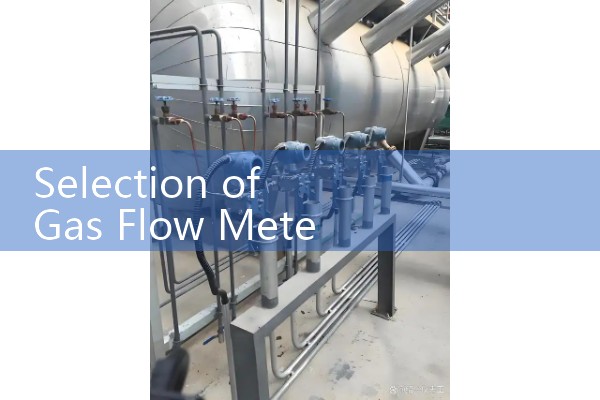
Common gas flow meters include vortex street, orifice plate, float, vortex, gas turbine, power bar, and bend pipe. Vortex street can measure most gas media. It can measure gas volume flow rate and mass flow rate, and can be used for high temperature and high pressure search and flammable and explosive gases. Orifice plates can also measure most gas media, but due to their low measurement accuracy and the need for multiple accompanying instruments, they are expensive and have gradually been replaced by vortex streets. Float flowmeter is mainly used to measure the flow rate of small caliber instruments, which cannot be achieved by other flowmeters for small flow measurement. Weiliba is used for gas measurement. Due to the presence of tar in gas, differential pressure instruments are generally unable to measure due to blockage. It is specifically designed for gas measurement. Spiral vortex and gas turbine are mainly used for measur